How Family-Run Manufacturers Keep Everyone Accountable Without Micromanaging
There is a specific kind of pressure that only family-run and privately owned manufacturing businesses feel.
You are not a faceless corporation. No HR department exists to absorb the friction. No compliance team sits in the background handling the hard conversations. You are the owner who walked the floor before the morning shift started. Your name is on the building. Your family relationships tangle up with business relationships in ways no management textbook will ever address honestly.
You want your team to do their jobs well. You want information to flow without constant chasing. Your floor leads should own their sections without needing someone standing over them every hour.
But somewhere between 15 and 30 employees, something shifts. The shop that ran fine on trust and verbal agreements starts to spring leaks. Deadlines get missed. Departments point fingers at each other. A critical step gets skipped because nobody wrote it down. Fixing it feels like two options: start micromanaging, or hope things sort themselves out.
There is a third option. This guide covers a practical approach to small manufacturing team management that gives everyone clarity, keeps work moving, and lets the owner step back from being the only person holding everything together.
Why Accountability Breaks Down in Small Manufacturing Teams
Before talking about solutions, it helps to understand why this happens. It is not a character issue with your team.
The informal trust trap
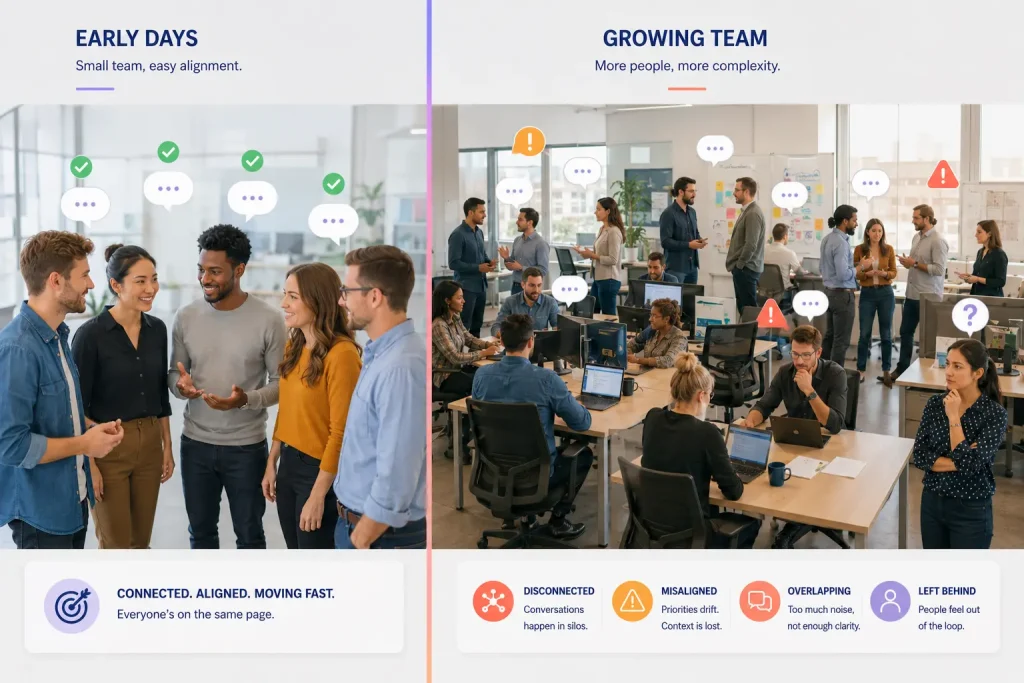
Family-run and privately owned manufacturing businesses build on informal trust. In the early years, that trust creates a genuine competitive advantage. Decisions happen in conversations. People go the extra mile because they know the owner personally.
The problem emerges when informal trust stops scaling. With 8 people, everyone knows what everyone else is doing. With 25 people across two shifts, that natural visibility disappears. The informal systems stay in place long after they stopped working. Changing them feels like admitting something is broken, or like you no longer trust the people who have been there since the beginning.
The accountability gap
This is the accountability gap. People have not stopped caring. The systems for communicating expectations, tracking progress, and following up simply have not kept pace with the team size. For small-town manufacturer operations especially, where roles have always been informal, this gap widens slowly and invisibly until something breaks.
Manufacturing team alignment does not happen automatically as a business grows. It gets deliberately built into how the team works day to day.
If you have been feeling this tension, the guide on common workflow challenges small businesses face is worth reading alongside this one. The patterns are nearly universal for privately held businesses that grow past a certain threshold.
What Micromanagement Actually Costs a Family Business
Many manufacturing owners end up micromanaging not because they want control over everything. They micromanage because the alternative feels like chaos. Without visibility into what is happening on the floor, hovering feels like the only way to stay informed.
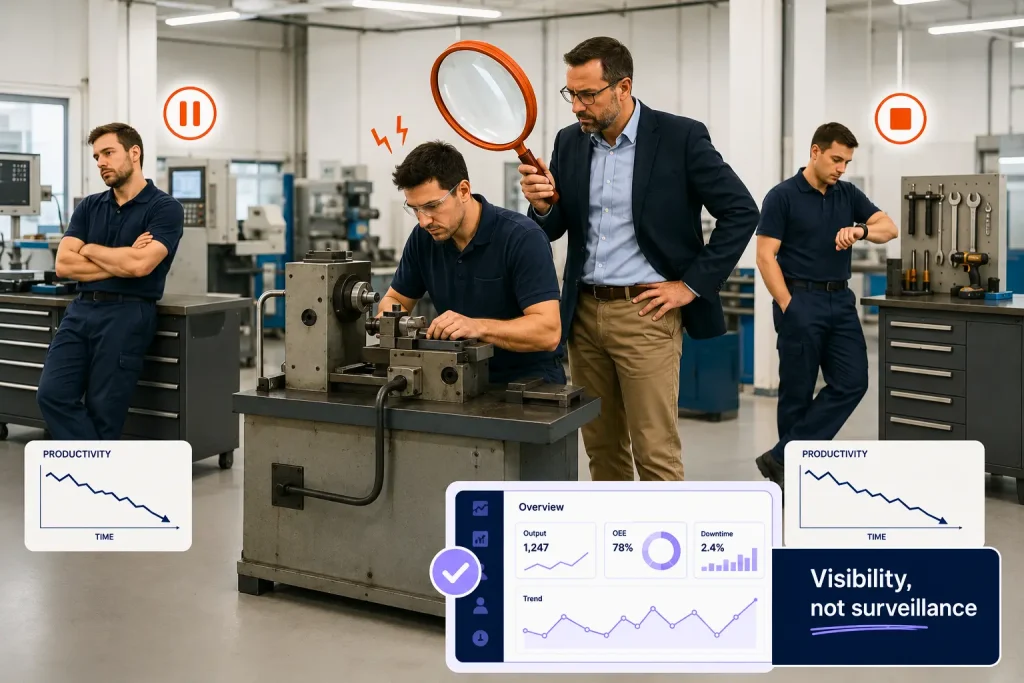
The cost is real. It compounds over time.
What workers do when they feel watched
Experienced workers who feel micromanaged stop making judgment calls. They wait for instructions instead of solving obvious problems. They disengage from outcomes because decisions always end up being someone else’s call. In a family business, this dynamic hits hardest with the workers who have been there longest. Those same workers tend to hold the institutional knowledge the business cannot afford to lose.
The real goal
The goal of accountability without micromanagement is not blind trust. It means building systems that surface information early enough to course-correct without hovering. Clear ownership motivates team members to manage themselves.
This is the core shift that effective leadership for small manufacturers requires: moving from being the person who enforces accountability to being the person who built the system that creates it.
This leadership challenge appears in 10 signs your business needs better task management, where early warning signs show up as visibility problems before they ever become performance problems.
The Three Layers of Accountability in a Small Manufacturing Shop
Accountability in a small manufacturing team is not one thing. Three levels operate simultaneously, and most shops only address one of them.
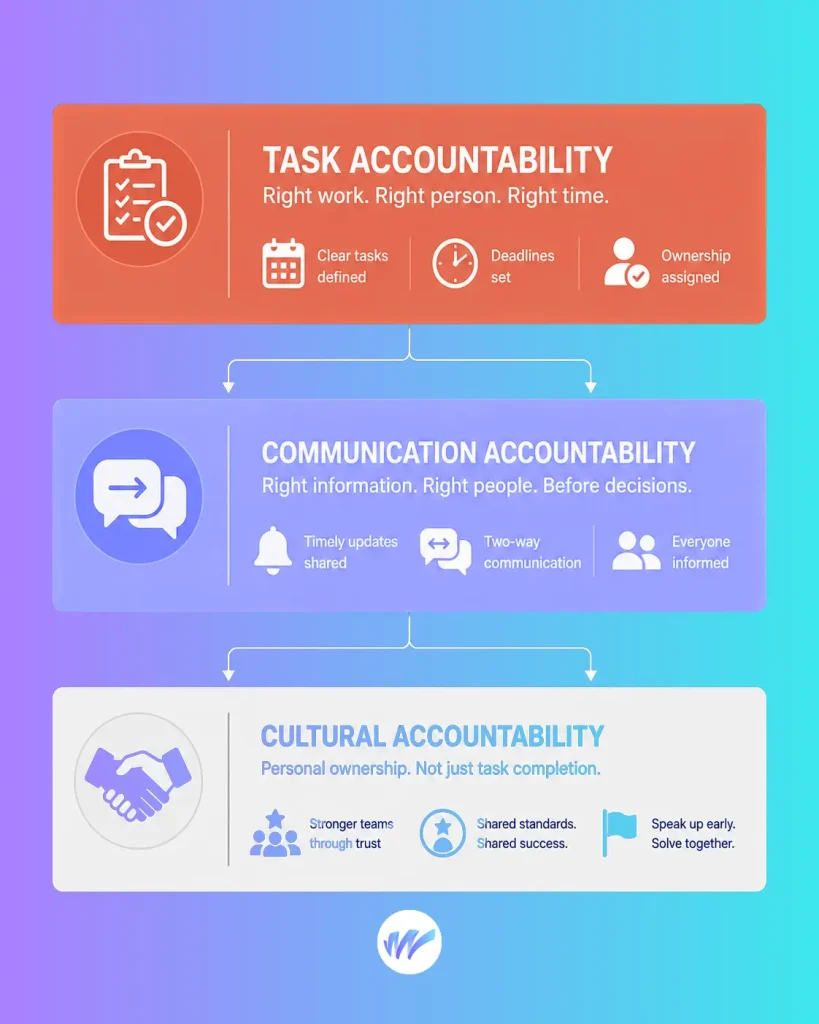
Layer one: Task-level accountability
This layer covers whether the right work gets done by the right person at the right time. Most owners try to address this first, usually through daily check-ins, whiteboard updates, or spreadsheet trackers that nobody keeps current.
The core problem with task tracking in small shops is that it lives in one person’s head. Usually that is a floor lead or the owner. When that person is absent or distracted, visibility disappears entirely.
Layer two: Communication accountability
This layer covers whether the right information reaches the right people before decisions get made. Schedule changes need to reach the floor before a shift starts. Quality issues need flagging before they become a client complaint. Maintenance problems need reporting before they stop a machine at the worst possible moment.
Most small manufacturers develop a floor communication problem long before they develop a productivity problem. Workers do their jobs, but information gets siloed by shift, by department, or simply by who happened to talk to whom on a given day.
Layer three: Cultural accountability
This layer covers whether team members feel personally responsible for outcomes, not just tasks. It is the difference between a worker who flags a problem on sight and a worker who walks past it because it is not their assigned responsibility.
No software tool manufactures cultural accountability. The right environment either enables it or destroys it. When people have clear ownership, see how their work connects to broader outcomes, and get recognized for doing the right thing, accountability becomes self-sustaining.
Most accountability frameworks focus only on layer one. The shops that get it right address all three.
From “Tell Me What You Did” to “Here Is What I Can See”
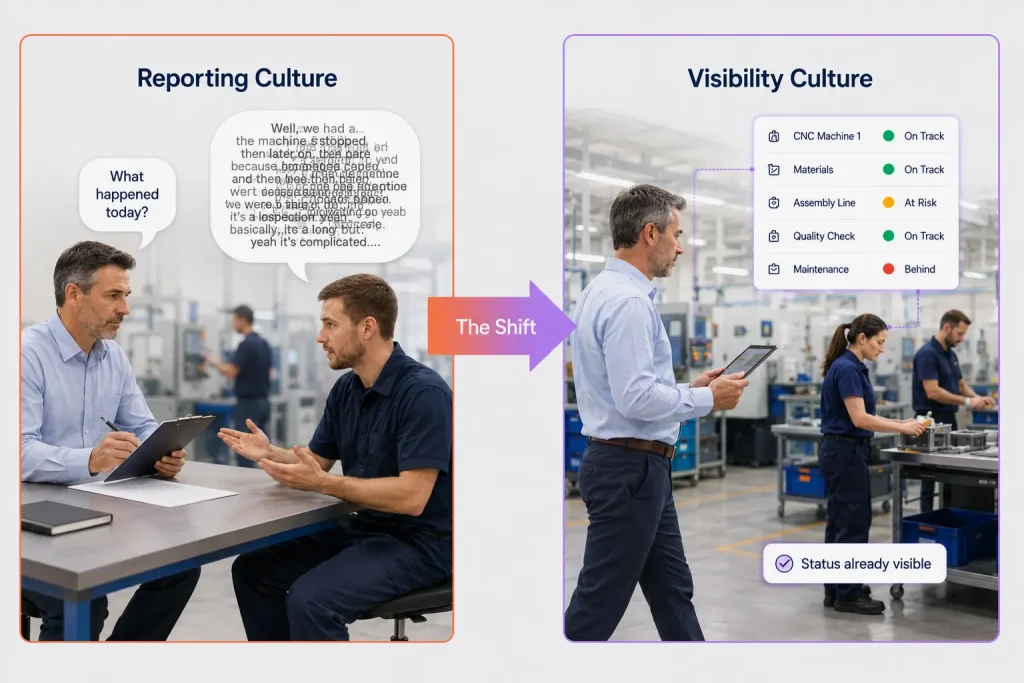
Reporting culture vs visibility culture
One of the most powerful changes a small manufacturing owner can make is moving from a reporting culture to a visibility culture.
In a reporting culture, accountability means asking people what happened. Status meetings, check-in conversations, end-of-day summaries. People report what they want you to know, not necessarily what you need to know. The act of asking creates a dynamic that feels like surveillance, even without that intention.
In a visibility culture, the system surfaces information automatically. Task statuses update as work progresses. Schedule changes notify the right people without anyone relaying a message. When a deadline runs at risk, the system flags it before the deadline passes.
Why this matters to the team
The shift sounds subtle. The difference in how the team experiences it is significant. Nobody enjoys being asked to report. Most people accept a system that simply shows what they are working on. It removes the ambiguity about being judged and replaces it with a straightforward record of the work.
How Wispa creates visibility
Wispa’s task and project management tools create this visibility for small manufacturing teams. Deadlines stay visible to everyone who needs them. Status changes log as they happen. The floor lead does not update a whiteboard from memory. The owner does not ask for a status update because the status already exists in the system.
For a practical look at how this plays out across an actual workday, the piece on a day in the life of a manager using Wispa shows the morning-to-close rhythm of a team that runs on shared visibility rather than check-in calls.
Shop Floor Communication: What Works and What Quietly Breaks Teams
Bad communication in a manufacturing shop rarely announces itself. It accumulates quietly until something expensive happens, and then everyone acts surprised. The warning signs were there for months.
To reduce chaos in manufacturing, start with communication structure. Not productivity tools. Not incentive schemes. Not new hires.
Here are the shop floor communication tips that address root causes rather than symptoms, and the patterns that show up most often in family-run and small-town manufacturing businesses.
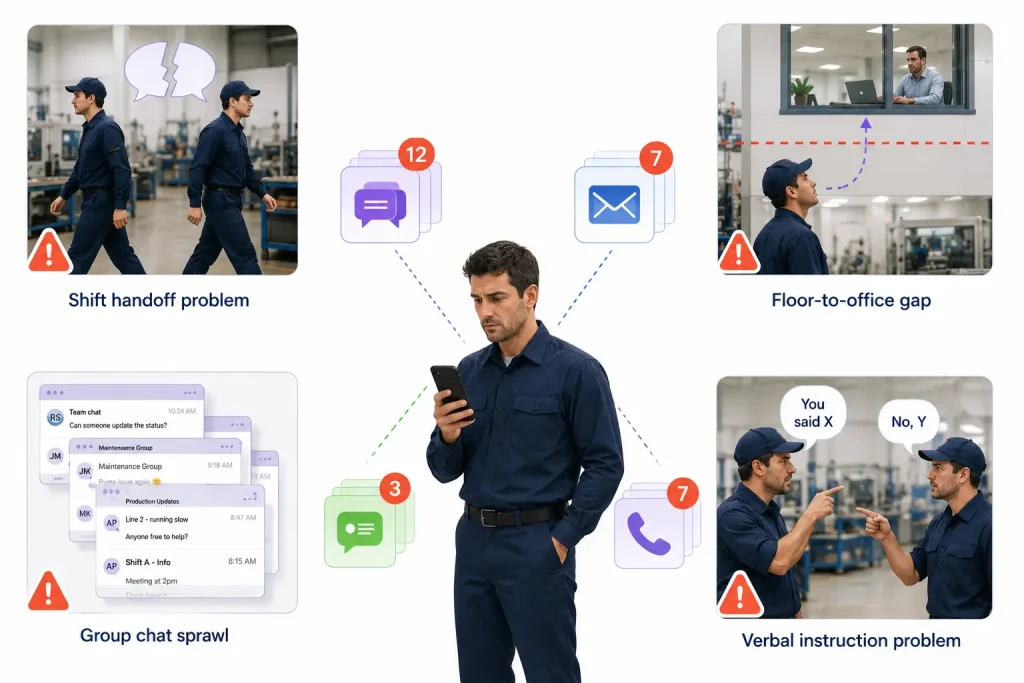
The four patterns that quietly break teams
The shift handoff problem. Critical information does not survive the transition between shifts. Handoffs are verbal, rushed, and inconsistent. The morning crew does not know what the night crew noticed. Quality issues get rediscovered rather than resolved.
The floor-to-office gap. Floor workers hold information that management needs. Reporting upward feels risky or pointless, so it does not happen. By the time a problem reaches the owner, it has been quietly growing for days.
The group chat sprawl. The business runs on personal WhatsApp groups, text threads, and email chains that nobody can fully search or audit. Context lives in multiple places. It regularly gets lost.
The verbal instruction problem. Decisions get given verbally on the floor, not written down, and then remembered differently by different people. Disputes over what was agreed become a constant source of low-grade friction.
The fix
Wispa’s unified communication hub brings all of these threads into one place. Messages attach to the relevant task or project, so context stays connected to the work it belongs to. This is not about replacing the informal culture of a family business. It makes sure the information that matters does not fall through the gaps between conversations. For more on this, 5 productivity hacks for teams working across projects and locations covers why consolidating communication consistently delivers the highest-impact change.
Managing 20+ Employees When You Cannot Be Everywhere at Once
Managing 20 or more employee teams with the same informal methods that worked at half that size is one of the most common and costly mistakes in small manufacturing growth.
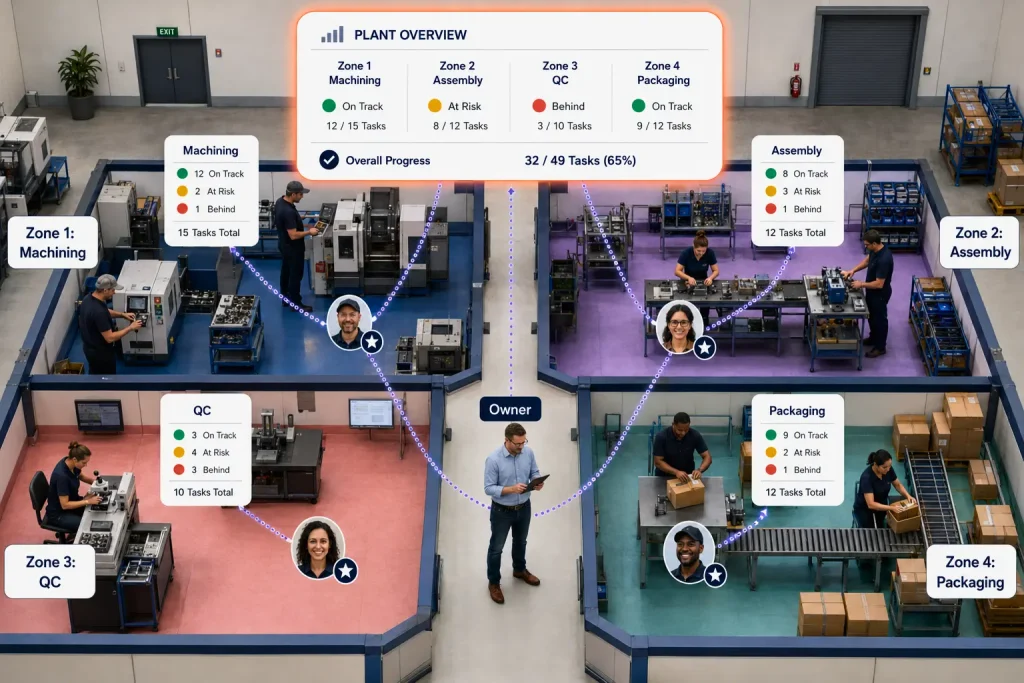
At a certain team size, usually between 20 and 35 people, the owner of a privately held manufacturing business hits a nearly universal wall. Personal presence and direct relationships no longer keep everything aligned. The management infrastructure has not been built to replace that presence with something systematic. The owner remains the primary information node, decision-maker, and accountability mechanism. When the owner is not present, things slip.
The real solution
Hiring a middle management layer immediately is not the answer. For most small-town and family-run shops, that is not financially realistic. It often creates more problems than it solves.
The real solution distributes visibility and accountability systematically. The owner no longer needs to be the only person who can see the full picture.
Here is what that looks like in practice.
Three shifts that change everything
Floor leads get real ownership, not just responsibility. There is an enormous difference between telling a floor lead they are responsible for their section and giving them a system where they can see every task status, flag problems upward with one tap, and communicate with their crew without verbal relay. Responsibility without visibility is just anxiety. Visibility plus responsibility creates actual ownership.
Escalation paths become clear and fast. When something goes wrong on the floor, the right person needs to know within minutes. Wispa’s reminders and notification system lets teams configure alerts so the right person gets notified immediately when a task gets flagged, a deadline runs at risk, or a status changes in a way that warrants attention.
The owner gets a dashboard, not a to-do list. Leading rather than doing requires a different kind of information. Not “what tasks are open” but “where are we at risk, and does anything need my direct attention today.” Wispa’s dashboard gives manufacturing owners that high-level read without digging into individual task threads every morning.
Protecting Institutional Knowledge in a Family Business
This is the part of workforce management for small businesses that almost no one talks about until it is too late. The problem runs especially deep in family-run shops where the most knowledgeable people have worked there so long that nobody has thought to ask them to document anything.
The knowledge risk most owners underestimate
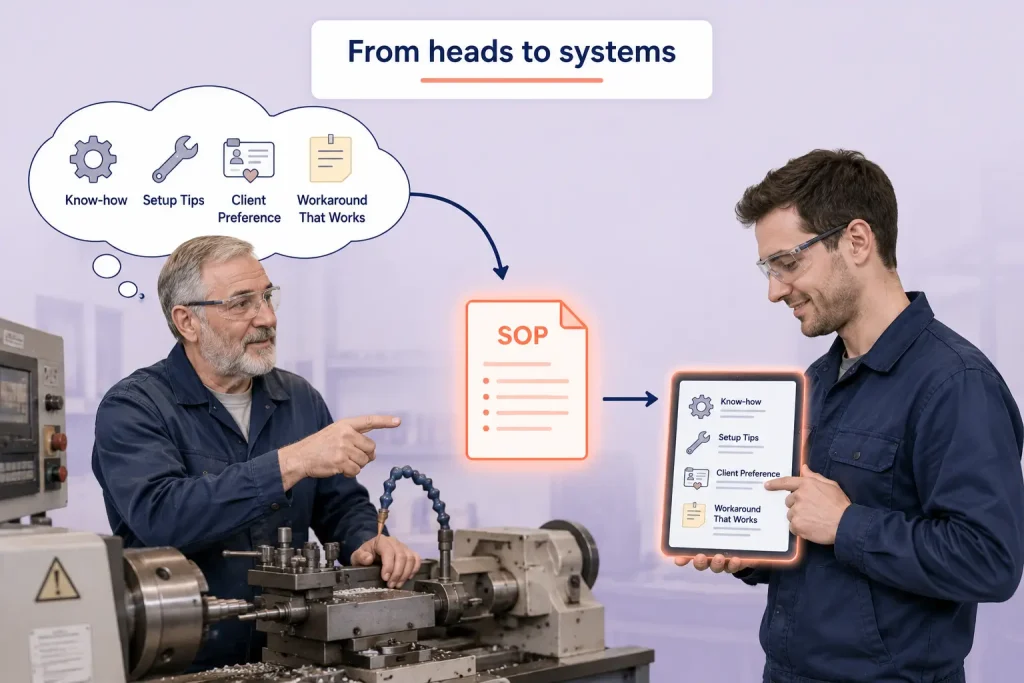
Family-run manufacturing businesses tend to have a small number of people who know everything. They know the quirks of every machine. They know which clients have unusual preferences. They know the workarounds for processes that were never properly documented because they were the ones who figured those workarounds out.
When one of those people leaves, retires, or goes on extended medical leave, the knowledge gap hits immediately. It is often severe.
Building a knowledge system before you need it
The honest fix is not complicated. It requires starting before the need becomes urgent. Build systems that capture how work actually gets done rather than how it is supposed to get done. That way, the knowledge embedded in experienced workers becomes accessible to the whole team rather than locked in individual heads.
Wispa’s AI assistant generates standard operating procedures, work instructions, and process documentation in minutes rather than hours. When floor leads build task workflows inside the platform, those workflows automatically become a record of how the work is structured. Combined with the documentation methods covered in the workflow management beginners guide for small business owners, this approach protects a family manufacturing business from the most common and most preventable operational crisis it faces.
The Family Business Dynamic: When Accountability Conversations Get Complicated
One aspect of managing a family-run or closely held manufacturing business gets ignored by generic management advice entirely. The conversations are not just professional. They are personal.
Telling a non-family employee that their performance is slipping feels uncomfortable. Telling a cousin, a brother-in-law, or a longtime friend who practically grew up in the business is a completely different situation. The relationship, the family dynamic, and the shared history all become part of the conversation, not just the job.
Why systematic accountability helps
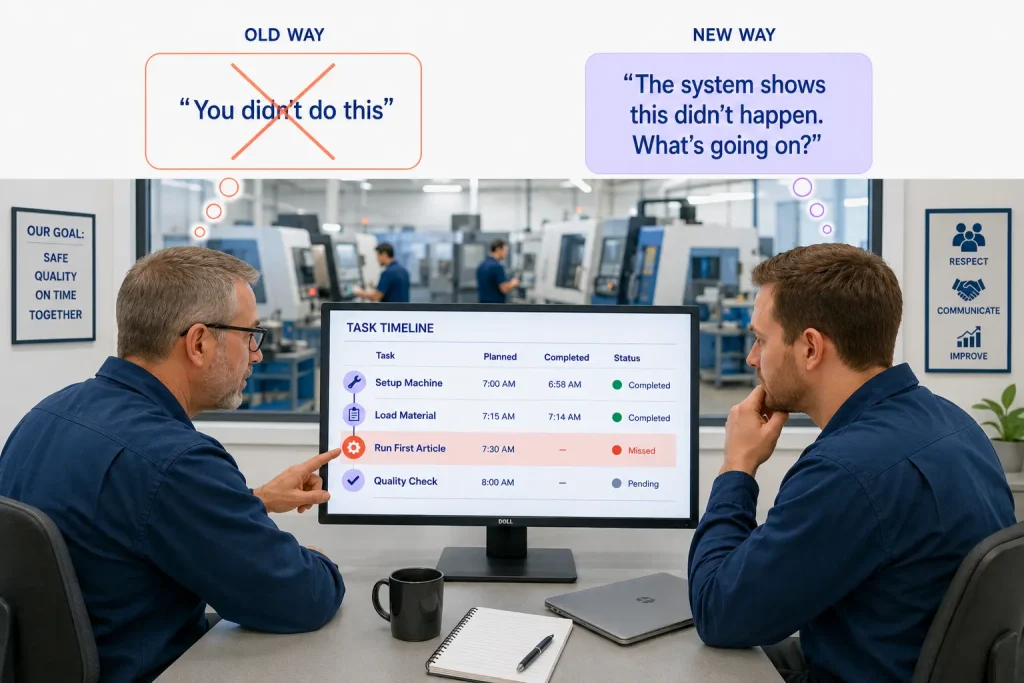
This is one of the most underappreciated reasons why private manufacturing businesses benefit from systematic accountability. When a system surfaces that a task was not completed on time, the conversation shifts. Instead of “I noticed you did not do this,” it becomes “the system shows this did not get done, what happened?” That shift changes the emotional temperature of the conversation dramatically.
Good systems reduce the number of difficult personal conversations. Problems surface earlier, when they are still small and fixable. Accountability becomes part of the workflow rather than a periodic confrontation.
Where automation fits in
This is also why automation matters so much in a small team. When deadlines trigger reminders automatically and approvals route to the right person without manual nudging, follow-up friction disappears. The guide on automate recurring tasks with Wispa in three clicks walks through exactly how this works for common manufacturing workflows.
What Wispa Does for Family-Run and Privately Owned Manufacturing Teams
Wispa is not a manufacturing ERP. It is a business management platform built to solve the people, communication, and accountability problems that cause small manufacturing shops to struggle as they grow.
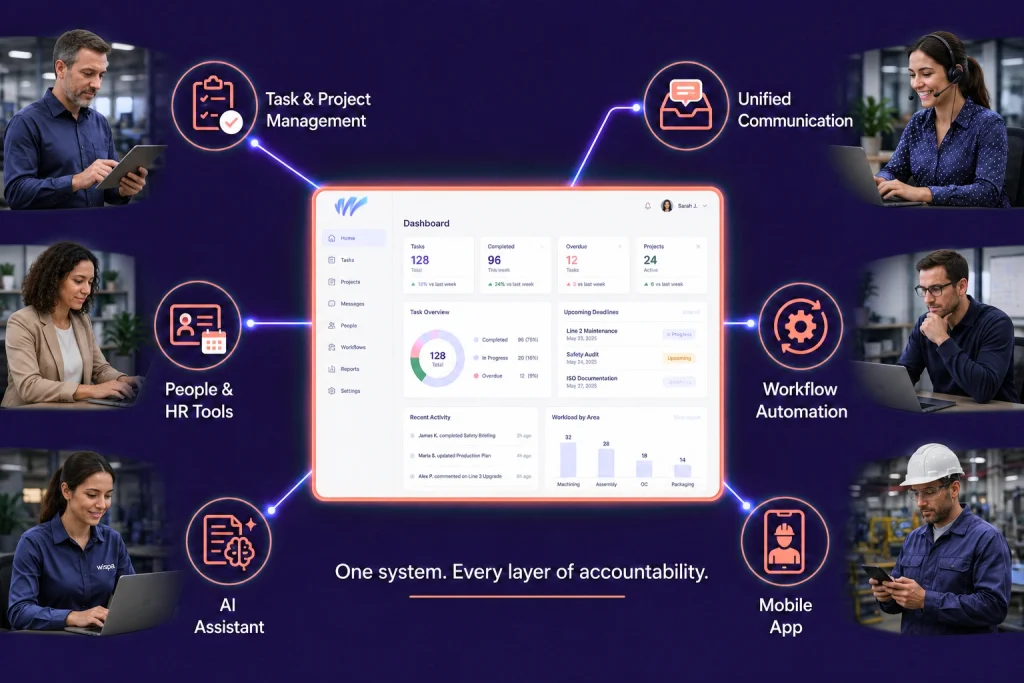
Here is what that looks like in practice for a team of 20 to 75 people.
The core features
Task and Project Management gives every person on the team clarity about what they own, what the deadline is, and the current status, without the owner manually relaying that information to multiple people every morning.
Unified Communication replaces the mix of group chats, personal texts, and email threads with a single inbox. Messages attach to the work they belong to. Shift handoffs, quality flags, and schedule changes reach the right people without routing through the owner.
People and HR Tools handle leave requests, schedules, contracts, and performance records in one place. No more managing HR in your head while tracking schedules in a separate spreadsheet.
Workflow Automation removes the manual follow-up that eats disproportionate manager time in a small shop. Recurring tasks trigger on schedule. Approvals route automatically. Nothing slips through because someone forgot to follow up.
The AI Assistant generates SOPs and process documentation from the workflows your team already uses. Institutional knowledge gets captured before it walks out the door.
Mobile App gives floor leads and workers access from anywhere on the floor. In a manufacturing environment where people are rarely sitting at a desk, this matters every single day.
For a look at how all of these features work together as one connected system, the piece on one powerful system to rule them all explains why consolidating into one platform consistently outperforms running multiple disconnected tools.
How to Roll This Out Without Disrupting Production or Alienating Your Team
The biggest fear for a family-run manufacturing business adopting new systems is that it feels like a betrayal of the culture that built the business. Introducing formal accountability to a team built on trust can feel like saying you no longer trust them.
The framing matters enormously here.
What this rollout is really about
This is not about replacing trust with surveillance. It is about giving trust a structure. When everyone sees the same information, misunderstandings decrease. When processes are documented, new people learn without burdening the veterans. When tasks are tracked, nobody gets blamed for dropping a ball that was never clearly assigned to them.
The phased rollout
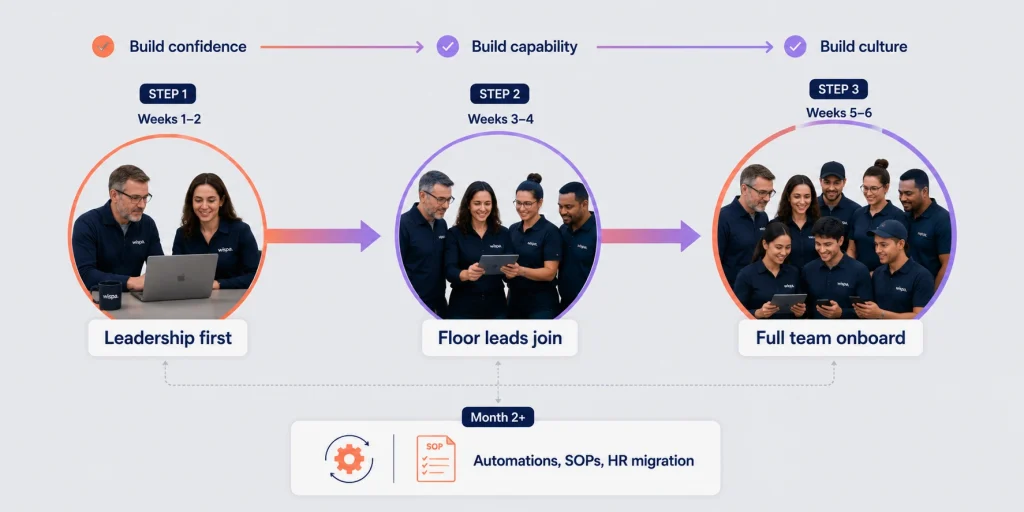
Weeks one and two: Start with management only. Get the owner and senior leads using Wispa for task tracking and communication before introducing it to the floor. This prevents the rollout from feeling like something done to the workers rather than for them.
Weeks three and four: Bring in your floor leads. Have them manage section tasks and communicate with the team through the platform. Keep existing methods running alongside it so no pressure forces a cold switch.
Weeks five and six: Introduce the full team. Leads are comfortable enough to support their crews through the adjustment. The team sees leadership already using the tool before they are asked to use it themselves. That sequence changes the dynamic entirely.
Month two onward: Build out automations, start capturing SOPs, and migrate HR processes. This is when the accountability infrastructure starts to compound. The owner begins shifting from being the primary information node to having a system that carries that load.
For a closer look at how this plays out in real productivity terms, the piece on why workflow management is critical for small business growth covers the structural reasons this investment pays off disproportionately for privately held businesses.
Wispa includes guided onboarding and setup support, so you are not figuring this out alone.
The Bottom Line
Family-run and privately owned manufacturing businesses have something large corporations spend years trying to create: a team that genuinely cares about the outcome because they know the people their work affects.
The challenge is not motivation. It is structure.
As the team grows, the informal systems that held everything together at 12 people stop scaling at 25. Not because people stopped caring. The business simply outgrew communication and accountability systems that were never designed for this size.
Abandoning the culture of trust that built the business is not the answer. Giving that trust a structure is. Clear ownership, visible deadlines, reliable communication, and documented processes protect the institutional knowledge your most experienced people carry.
Wispa is built for exactly this kind of business. It is flexible enough for a 15-person shop and capable enough for a 75-person operation. No IT department required. No six-month implementation. No ERP complexity that buries the operational clarity you actually need.
Try it free for three months, no credit card needed, and see what it feels like when everyone on the team sees the same information at the same time.
Frequently Asked Questions
The key is shifting from personal oversight to systematic visibility. When tasks, deadlines, and communication are tracked in a shared system, team members can see what is expected of them without being watched. Problems surface to managers automatically rather than requiring constant check-ins. The system carries the accountability load rather than the owner’s personal presence.
At this size, informal management structures start to break down. The most effective approach combines clear task ownership, visible deadlines, consistent shift communication, and documented processes, so that every team member knows what they are responsible for and managers have real-time visibility without hovering. A platform like Wispa connects all of these elements in one place.
Chaos in manufacturing almost always has two root causes: unclear ownership of tasks and decisions, and information that is not reaching the right people at the right time. Fixing chaos means defining who owns what, making sure deadlines are visible before they pass, and creating a communication structure where problems travel upward quickly rather than getting absorbed at the floor level.
Yes. Wispa is specifically designed for privately held businesses that want the operational clarity of a larger organization without the complexity or cost of enterprise software. It does not require a dedicated IT team or a lengthy implementation. The guided onboarding and three-month free trial make it accessible for small manufacturing teams at any stage.
Start documenting processes before you need to. Wispa’s AI assistant can generate standard operating procedures from existing workflows, and the task structure your team builds inside the platform becomes a living record of how work gets done. The goal is getting critical knowledge out of individual heads and into a shared system before a key person leaves or is unavailable.
Most small manufacturers find the tipping point somewhere between 15 and 25 people. Below that, informal systems often still work reasonably well. Above it, the coordination overhead of managing without a shared system starts to cost more in missed deadlines, duplicated effort, and management time than the software itself.